


-300x225.webp) For decades, the debate between tracked and wheeled undercarriages has shaped how contractors, fleet managers, and equipment operators approach earthmoving projects. The decision is never trivial: it directly influences daily productivity, operating costs, site access, and long-term machine value—especially when evaluating used excavators for resale or replacement. While modern hydraulic systems and engine technologies have advanced significantly, the fundamental question remains: do rubber tires or steel tracks deliver superior mobility and performance for your specific application?
For decades, the debate between tracked and wheeled undercarriages has shaped how contractors, fleet managers, and equipment operators approach earthmoving projects. The decision is never trivial: it directly influences daily productivity, operating costs, site access, and long-term machine value—especially when evaluating used excavators for resale or replacement. While modern hydraulic systems and engine technologies have advanced significantly, the fundamental question remains: do rubber tires or steel tracks deliver superior mobility and performance for your specific application?
This article provides a comprehensive, technical comparison of excavator tracks versus wheels across key operational dimensions. We will analyze ground pressure, traction, travel speed, gradeability, maintenance burden, fuel efficiency, and lifecycle economics. Additionally, we will extend the discussion to other machinery such as compact loaders, bulldozers, and backhoes, where undercarriage design follows similar engineering principles. By the end, you will have a clear framework for matching undercarriage type to job site conditions, without relying on oversimplified generalizations or marketing claims.
Every point is grounded in mechanical engineering fundamentals and field-proven performance data, ensuring that the insights apply equally to brand-new units and well-maintained used excavators available on the secondary market. The goal is not to declare an absolute winner, but to equip you with the knowledge to make a site-specific, cost-effective choice.
2. Fundamentals of Excavator Undercarriage Design
2.1 Tracked Undercarriage Components
Tracked excavators use continuous steel bands (or rubber tracks on mini excavators) driven by sprockets, idlers, track rollers, and carrier rollers. The contact area is distributed across dozens of track shoes, creating a long, rectangular footprint. Key design parameters include track pitch, shoe width, grouser height, and the number of bottom rollers. These elements determine how the machine interfaces with soft soils, slopes, and rocky terrain.
2.2 Wheeled Undercarriage Components
Wheeled excavators ride on pneumatic tires mounted on rigid or oscillating axles. Most models feature four-wheel drive, hydrostatic or mechanical transmission, and steering axles (rear or all-wheel steering). Tire tread patterns range from smooth (for roading) to deep lug (for off‑road traction). Suspension systems, though minimal compared to automotive designs, help absorb shocks during high-speed travel between job sites.
2.3 Key Differences in Force Transmission
Tracks convert engine torque into tractive effort through a large, low‑pressure contact patch. This minimizes sinkage in soft ground. Wheels concentrate machine weight onto smaller contact areas (four or six tire patches), generating higher ground pressure but enabling faster rolling speeds on hard surfaces. The fundamental trade‑off is between flotation/slip resistance and travel speed/road legality.
3. Mobility Analysis: Tracks vs. Wheels
3.1 Travel Speed and Roading Capability
Wheeled excavators excel in applications requiring frequent relocation over paved or compacted surfaces. Typical top speeds range from 20 to 40 km/h (12 to 25 mph), allowing operators to drive between nearby sites without a low‑bed trailer. This dramatically reduces transport costs and downtime. Used excavators with wheeled undercarriages are particularly popular among urban contractors, road repair crews, and utility companies where highway moves are routine.
Tracked excavators, by contrast, rarely exceed 5 km/h (3 mph) on their own. Moving a tracked machine more than a few kilometers requires a trailer and heavy haulage permits. However, recent innovations in rubber-tracked compact excavators have narrowed this gap slightly—some midi models now reach 12 km/h (7.5 mph), but still cannot match wheeled speed.
3.2 Maneuverability in Confined Spaces
Wheeled excavators typically incorporate independent steering modes: front-wheel, crab, and all-wheel. This enables tight turning radii and precise positioning near obstacles. For example, a wheeled excavator can crab sideways to align with a trench while leaving the cab perpendicular to the excavation line. However, the pivot point is near the center of the machine, which can cause rear swing interference.
Tracked excavators achieve zero‑tail‑swing or reduced‑tail‑swing designs, but steering is accomplished by counter‑rotating tracks (skid steering). This imposes high ground stresses and can tear up turf or asphalt. In extremely confined indoor demolition or basement excavation, a compact tracked unit often outperforms wheeled models because it rotates within its own length and exerts lower surface pressure on finished floors (when using rubber pads).
3.3 Grade Climbing and Side Slope Stability
Tracks provide superior grip on slopes exceeding 30% grade. The long track frame distributes traction across many grousers, reducing the risk of slipping even on wet clay or loose gravel. Tracked excavators routinely work on 35–40% side slopes with proper counterweighting. This makes them the default choice for forestry, pipeline construction, and mining operations.
Wheeled excavators struggle on gradients beyond 25% unless equipped with differential locks and aggressive tires. Side slope operation is especially hazardous because the narrow tire contact patches can lose lateral grip, causing the machine to slide downhill. Manufacturers often specify reduced lift capacities when working on slopes with wheeled models.
3.4 Obstacle Crossing and Ground Clearance
Wheeled excavators generally offer higher ground clearance (400–500 mm) under the axle differentials, allowing them to roll over stumps, rocks, and curbs without high‑centering. Tracks, especially on larger machines, have lower belly clearance (300–400 mm), increasing the risk of undercarriage impact. However, the continuous track bridge can spread the load over irregular obstacles, whereas a wheel might fall into a rut and lose traction.
For other machinery like skid steer loaders, similar trade‑offs exist: wheeled skid steers hop over obstacles at speed, while tracked versions maintain steady contact but risk catching the track on sharp projections.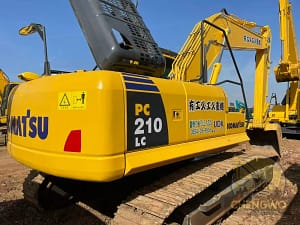
4. Performance Factors in Working Conditions
4.1 Traction and Drawbar Pull
Tracks produce higher net traction coefficients (0.6–0.8 on loose soil) compared to wheels (0.3–0.5). The long contact length allows the track to develop continuous shear stress along the soil surface. Consequently, a 20‑ton tracked excavator can generate roughly 30% more drawbar pull than a similarly powered wheeled excavator. This translates into faster cycle times when digging into compacted banks or pulling heavy attachments (e.g., rock saws, vibratory pile drivers).
Wheeled excavators rely on tire inflation pressure and tread design. Over‑inflation reduces contact area and traction; under‑inflation increases rolling resistance. Mud‑terrain tires improve off‑road grip but wear quickly on pavement. For used excavators, inspecting tire tread depth and sidewall cracks is as critical as checking track bushing wear.
4.2 Ground Pressure and Flotation
Static ground pressure for tracked excavators typically ranges from 30 to 80 kPa (4.4 to 11.6 psi) depending on shoe width and machine weight. This low pressure allows operation on sensitive surfaces: golf course renovations, pipeline reinstatement, or wetland construction without excessive rutting. Some ultra‑low‑ground‑pressure (LGP) track models achieve below 25 kPa, similar to a human footprint.
Wheeled excavators exert 200–400 kPa (29–58 psi) through each tire contact patch. On soft terrain, they immediately sink, lose traction, or cause damage to turf/agricultural fields. However, on firm ground, higher ground pressure is beneficial—it improves compaction for foundation preparation and provides a stable digging platform.
4.3 Digging and Lifting Stability
Because tracks offer a longer wheelbase (track length) and wider stance, they provide superior stability during heavy excavating and lifting. The tipping load for a tracked excavator is typically 15–20% higher than a wheeled model of the same operating weight. This directly impacts safety margins when handling suspended loads or ripping with a single tooth.
Wheeled excavators incorporate outriggers (stabilizer legs) to compensate for the narrower tire track width. When outriggers are deployed, the working stability approaches that of a tracked machine, but this adds setup time and reduces mobility between digging positions. Operators often skip outriggers for short‑cycle tasks, leading to increased tip‑over risk.
4.4 Fuel Efficiency per Unit Work
Tracks impose higher rolling resistance due to internal friction in the track chain, idler bushings, and final drives. Fuel consumption per operating hour for a tracked excavator is usually 10–15% greater than a wheeled unit performing similar digging cycles on firm ground. However, when working in soft conditions where wheeled machines would spin or require multiple passes, the tracked unit completes the task faster, sometimes achieving lower fuel per cubic meter moved.
For roading segments, wheeled excavators are dramatically more fuel‑efficient (liters per kilometer) than transporting a tracked machine on a truck. Fleets operating across scattered sites often find that the fuel savings from self‑propelled travel outweigh the higher hourly burn during digging.
5. Terrain Suitability and Application Matching
5.1 Soft Ground and Swampy Conditions
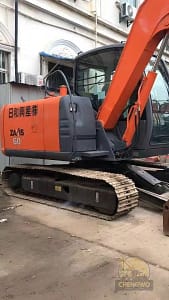
Tracked undercarriages are mandatory for wetlands, rice paddies, and coastal reclamation projects. LGP tracks with swamp shoes prevent sinkage and allow access that would swallow a wheeled machine. Used excavators from dredging or agricultural drainage projects almost exclusively feature extended tracks and sealed chains.
5.2 Rocky and Abrasive Terrain
Hard rock quarries and demolition sites present severe wear challenges. Steel tracks with heat‑treated bushings and hardened pins resist cutting and abrasion better than rubber tires. However, sharp rock fragments can penetrate tire sidewalls, causing sudden deflation. For other machinery like wheel loaders operating in quarries, solid foam‑filled tires are common, but such solutions are rare on excavators due to ride harshness.
5.3 Paved Surfaces and Urban Sites
Wheeled excavators cause minimal damage to asphalt, concrete, and interlocking pavers. Their rubber tires can be fitted with smooth treads for zero marking. Tracked machines, even with rubber pads, tend to scuff surfaces during turning because the tracks pivot against the ground. Municipal regulations often prohibit tracked equipment on finished roads without tracked mats.
5.4 Snow and Ice Operations
Tracks with aggressive grousers and optional ice studs provide reliable traction on frozen ground. Wheeled excavators require tire chains or self‑cutting studs, which reduce speed and damage pavement when transitioning to cleared roads. In cold climates, used excavators originally sold for pipeline work usually have cold‑weather track seals and heated final drives.
6. Maintenance and Cost Considerations
6.1 Undercarriage Wear Life
Tracked undercarriages are wear‑intensive. Components such as track links, bushings, sprockets, and rollers have finite lifespans measured in hours under specific conditions. Abrasive soil (silica, granite) can reduce track life to 1,500–2,000 hours; moderate conditions yield 4,000–6,000 hours. Replacing a full undercarriage on a 30‑ton excavator costs 15,000–25,000, representing a major ownership expense.
Wheeled excavators have lower wear component costs. Tires last 2,000–5,000 hours depending on terrain and rotation practices. Front axle kingpins, steering cylinders, and brake pads require periodic replacement, but the total undercarriage lifetime cost is roughly one‑third that of a tracked machine over 10,000 operating hours.
6.2 Routine Service Intervals
Tracks require daily cleaning of mud and debris to prevent premature bushing wear. Track tension must be adjusted weekly. Rollers and idlers need greasing at intervals specified by the manufacturer. Neglecting track maintenance leads to derailment, which can damage final drives and frames.
Wheeled excavators demand tire pressure checks, wheel bolt torque verification, and brake inspections. Steering linkages and outrigger pivot points require lubrication. Overall, the daily service burden is lower for wheels, but specialized tire repair tools (bead breakers, tire changers) are needed.
6.3 Impact on Used Equipment Valuation
When evaluating used excavators, the condition of the undercarriage is a primary price driver. A tracked machine with 80% track life remaining may command a 10–15% premium over one with 40% life. Sellers often measure track sag and bushing wear to document remaining service life. For wheeled units, tire condition and axle alignment records are equally critical. Buyers should factor in the cost of a new undercarriage (tracks or tires plus related components) within the first 1,000 hours of ownership.
6.4 Component Availability for Other Machinery
The same principles apply to other machinery such as compact track loaders (CTL) versus wheel skid steers. CTLs offer flotation and traction at the expense of higher undercarriage maintenance. Wheeled skid steers provide faster travel between jobs but tear up lawns. Fleet managers standardizing on one undercarriage type across excavators and loaders can reduce parts inventory and mechanic training costs.
7. Special Considerations for Used Excavators
7.1 Depreciation and Undercarriage Type
Tracked excavators typically depreciate faster than wheeled models because potential buyers fear hidden undercarriage wear. A machine that has worked in abrasive conditions may require an immediate $10,000+ rebuild, depressing resale value. Conversely, a wheeled excavator with good tires and documented service history holds value better, especially in regions where road travel is common.
7.2 Inspection Tips for Buyers
When inspecting used excavators, perform these undercarriage checks regardless of track or wheel configuration:
-
Tracked units: Measure track sag (should be 10–30 mm between carrier roller and track). Check for leaking track adjusters. Inspect sprocket tooth sharpness – new teeth have flat tops; worn teeth become pointed. Examine pin and bushing external wear – rotating pins 180 degrees can extend life but requires professional service.
-
Wheeled units: Check tire date codes (older than 5 years may have sidewall cracking). Inspect outrigger pads for wear. Verify that all-wheel steering (if equipped) does not have excessive free play. Pump the brake pedal – sponginess indicates air or fluid leaks.
7.3 Aftermarket Undercarriage Options
For both track and wheel machines, aftermarket components (track chains, sprockets, tires) can reduce repair costs by 20–30% compared to OEM parts. However, quality varies. When reconditioning used excavators for resale, many dealers use reputable aftermarket undercarriage kits to boost margins without compromising safety. Always verify that the component’s load rating matches the original specification.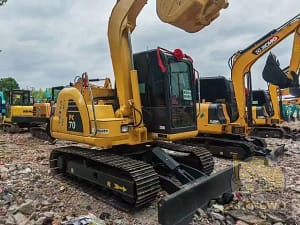
8. Extending the Comparison to Other Machinery
8.1 Wheel Loaders vs. Track Loaders
While this article focuses on excavators, other machinery in the earthmoving family exhibits identical trade‑offs. Wheel loaders dominate quarry and highway applications because of travel speed and tire longevity. Track loaders (front‑end loaders on tracks) are niche products for soft ground and steep slopes. Their undercarriage design borrows directly from tracked excavators, including the same wear and cost profiles.
8.2 Backhoe Loaders (Tractor‑Backhoes)
Most backhoes are wheeled, offering road speeds up to 40 km/h and the ability to dig from a stabilizer‑deployed stance. However, compact tracked backhoes (mini excavator with loader arm) have emerged. They outperform wheeled backhoes in wet conditions but require trailering between sites. For rental fleets, wheeled backhoes remain far more common due to transport convenience.
8.3 Telehandlers and Rough‑Terrain Forklifts
Telehandlers typically use large flotation tires, but tracked versions exist for agricultural and muddy construction sites. The same principle applies: tracks enhance flotation and slope performance while reducing travel speed and increasing maintenance. Most telehandler buyers choose wheels unless site conditions mandate tracks.
8.4 Dump Trucks and Haulers
Articulated dump trucks (ADTs) use large tires, but some mine haulers incorporate rubber‑track systems to reduce ground pressure in tailings areas. However, the vast majority of hauling equipment remains wheeled because roading distance and speed are critical to cycle times.
9. Conclusion
The choice between excavator tracks and wheels is not a matter of technological superiority but of operational alignment. Tracks deliver unmatched flotation, traction, and stability on soft or uneven ground, making them indispensable for heavy earthmoving, slope work, and sensitive terrain. Wheels provide speed, road legality, lower maintenance costs, and less surface damage on pavement, excelling in urban jobs and multi‑site applications.
When evaluating used excavators, pay close attention to undercarriage wear as it directly impacts purchase price and future repair bills. Similarly, for other machinery in your fleet, apply the same analytical framework: travel distance, ground conditions, and maintenance capacity are the three pillars of the decision.
No single undercarriage is perfect for all tasks. Smart fleet management involves matching machine configuration to the predominant site characteristics, and when the work profile is highly variable, owning both types or selectively renting specialized units ensures maximum profitability. By understanding the engineering trade‑offs detailed in this article, you can confidently specify, purchase, or operate excavators that deliver optimal mobility and performance for every job.